







 Our Recommended Reference Component awards are not reserved solely for the most expensive and/or highest-performing products in audio. While these components can certainly qualify, we also recognize more affordable products when they establish a meaningful benchmark against which other products can be judged. Furthermore, depending on the product type, when evaluating the candidates, we consider not only sonic performance but also user functionality—an increasingly important factor for today’s listeners, who expect modern hi‑fi products to integrate seamlessly into everyday use. That brings us to the WiiM Ultra streaming preamplifier (US$329, CA$499, £349, €349), reviewed by AJ Wykes on SoundStage! Simplifi in May of 2025.
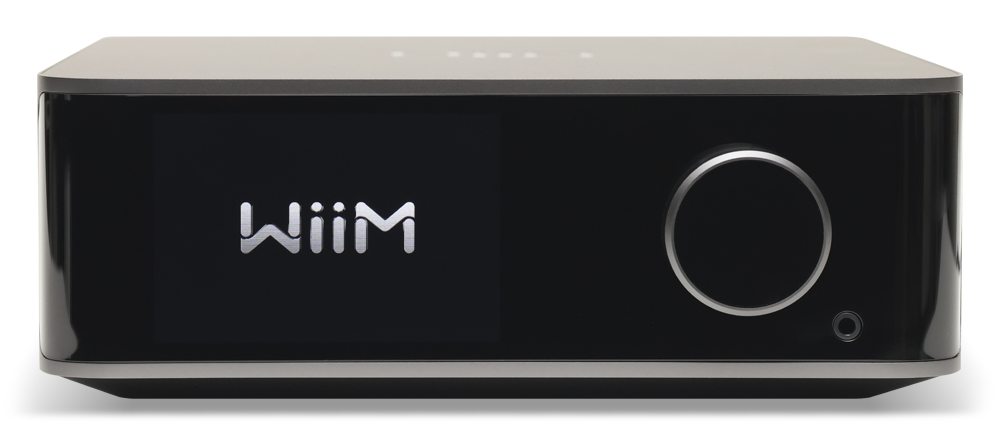
Founded by Linkplay Technology in 2014, WiiM draws engineering talent from companies including Google, Broadcom, and Harman, and that technology-oriented background shows clearly in the Ultra’s design philosophy, which is remarkably complete in terms of performance and functionality for what most audiophiles will consider an extremely low asking price. The Ultra is the top piece both in terms of cost and functionality in the company’s streamer lineup. WiiM also offers streaming integrated amplifiers, a power amplifier, and, most recently, speakers.
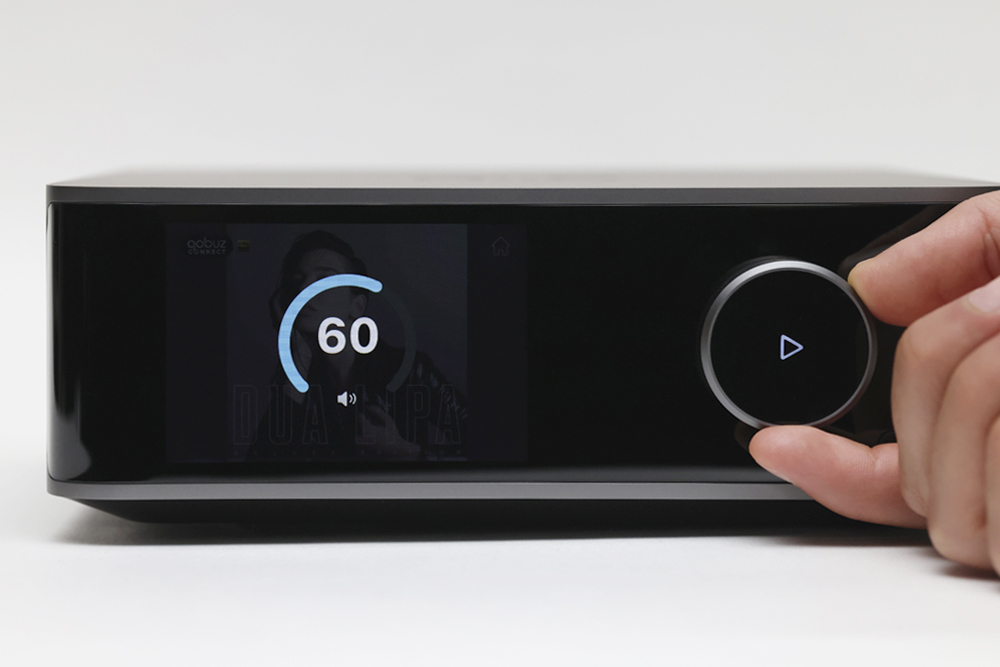
Physically, the Ultra is compact, at just 2.8″H × 7.9″W × 8.3″D, and light, weighing just 3.2 pounds. Still, it has an aluminum chassis and glass fascia that AJ found gives the unit a “quality appliance” feel upon unboxing. Although AJ felt that some elements—most notably the oversized volume knob—didn’t fully match the tactile refinement of costlier audio products, in his review he nevertheless praises the WiiM Ultra’s overall fit, finish, and visual presentation. AJ also describes the design as “refined” with “high-tech sleekness,” and with proportions and styling that would integrate comfortably into most contemporary audio systems.
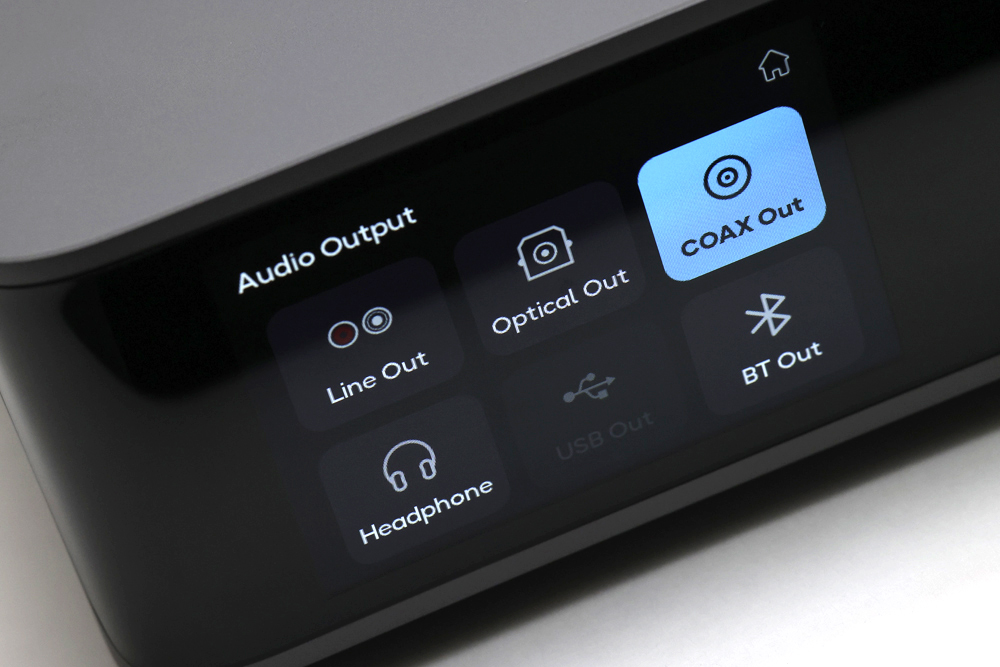
What truly separates the Ultra from many similarly priced products, however, is the sheer breadth of functionality packed into the chassis. The rear panel includes an optical S/PDIF input (TosLink), one pair of line-level analog inputs (RCA), one pair of line-level analog outputs (RCA), one pair of RCA inputs for the built-in moving-magnet phono stage, a dedicated mono subwoofer output (RCA) configurable through the built-in bass-management system, coaxial (RCA) and optical (TosLink) digital outputs, an HDMI ARC jack, an ethernet port, a USB port, and a front-panel headphone output (3.5mm). The USB implementation particularly impressed AJ because it not only supports external storage devices for local-library playback, but it also allows the Ultra to feed external USB DACs, with support for resolutions up to 32‑bit/384kHz PCM and DSD512.
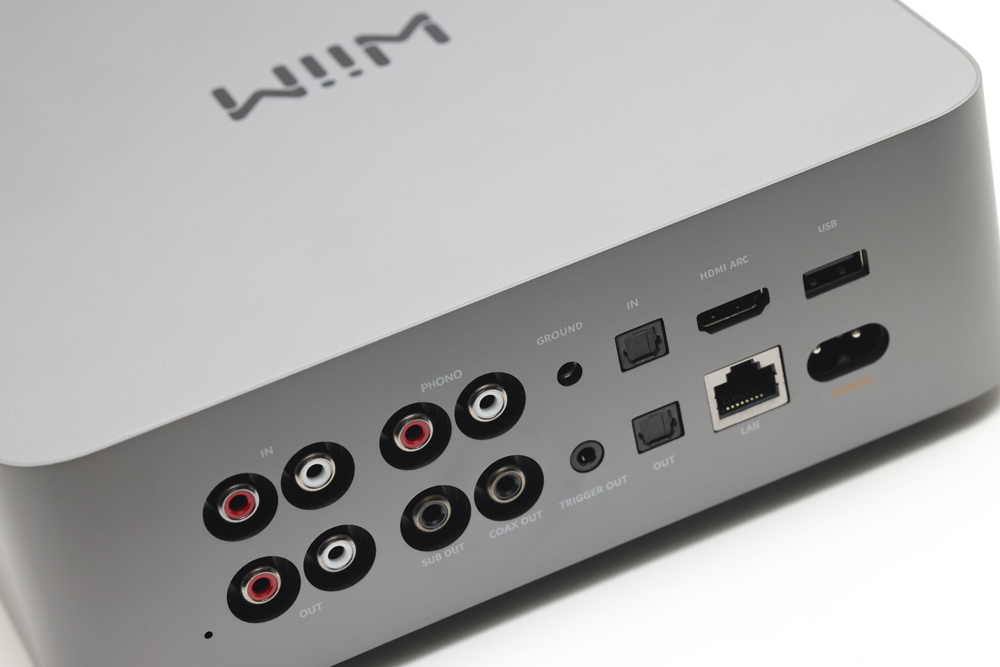
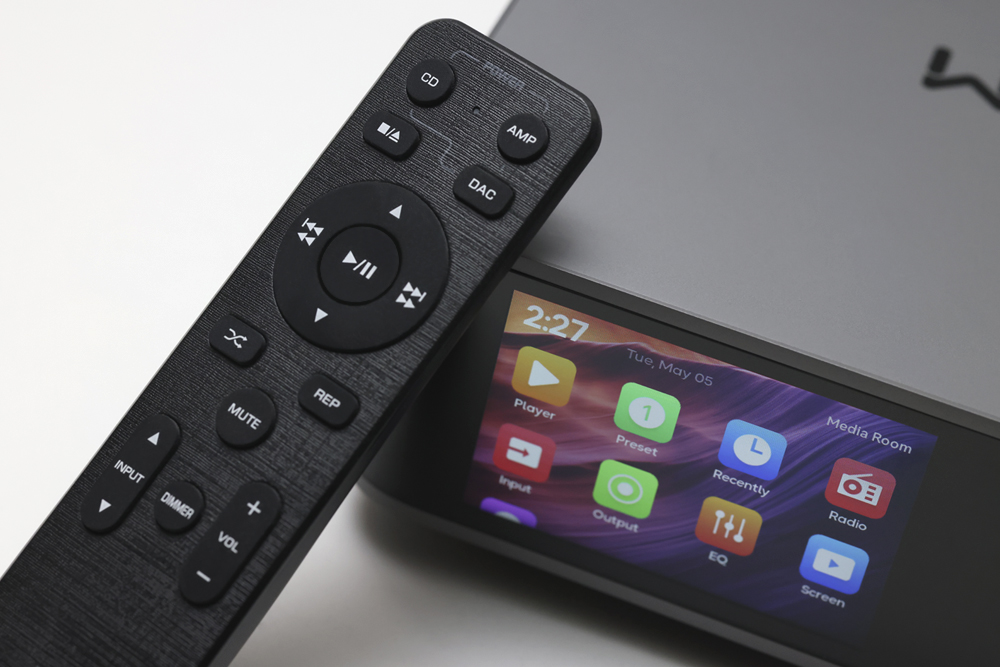
Should the user wish to use the Ultra as only a streamer, the digital outputs accomplish that. But the built-in digital-to-analog converter—based on an ESS Sabre ES9038Q2M chipset, which can operate at up to 32-bit/384kHz but is internally limited to 24/192—combined with the analog outputs, means that the Ultra can also operate as a standalone streaming DAC. Furthermore, with the volume control as well as line-level analog and phono inputs, the Ultra qualifies as a streaming preamplifier. It comes with a remote but is also fully controllable by the WiiM Home app.
Software integration is equally comprehensive. The Ultra supports Spotify Connect, Tidal Connect, Qobuz, Google Cast, DLNA, Roon, Squeezelite, Alexa integration, and extensive multiroom capabilities through WiiM’s own app ecosystem. AJ highlights the company’s aggressive firmware-development schedule, noting that significant features continued to arrive even during his review period—including expanded HDMI functionality capable of handling multichannel audio distribution across WiiM devices.
Much of the Ultra’s appeal, though, lies not just in the feature count, but in how effectively those features work together in practical use. The Ultra includes graphic EQ, parametric EQ, customizable presets, room correction, and unusually robust subwoofer integration for a product at this price. The bass-management system includes adjustable crossover settings, level controls, phase inversion, and timing compensation between the main speakers and subwoofer. AJ found these tools valuable because they allowed the Ultra to function as the genuine control center for a modern music system rather than merely as a streaming endpoint.
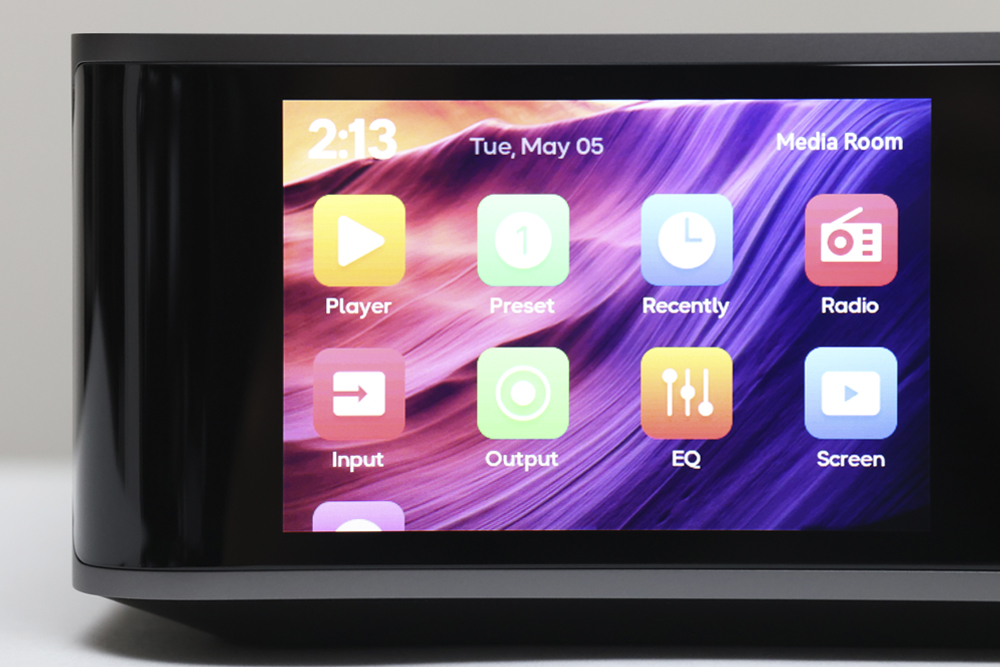
The room-correction implementation especially stood out, given the Ultra’s affordability. Although Wykes acknowledges in the review that the system was “fairly rudimentary” compared to more advanced correction platforms, he also found it highly approachable and effective. Using only a smartphone microphone, the WiiM was able to tame room-induced bass problems and improve overall clarity in his listening spaces. AJ emphasizes that such a system cannot be a substitute for proper room treatment, but through his experiences he nevertheless came to view it as an excellent and accessible entry point for listeners who might never have experimented with automated equalization before.
The sonic results ultimately justified the Ultra’s ambitious functionality. AJ evaluated the Ultra across three separate systems in different rooms, using combinations that included, among other components, Chord and ICEpower amplification; Tannoy, KEF, and Morning Factory loudspeakers; and a Rythmik Audio sub. He brought in a Chord Dave DAC for comparisons and streamed music primarily through Qobuz and Tidal, with additional playback from locally stored files.
Throughout those sessions, the Ultra distinguished itself by avoiding obvious coloration or exaggerated character. In his review, AJ describes the presentation as “clean” and “detailed,” with “a natural tonal balance that avoided excessive brightness or bass heaviness.” Just as importantly, he found the Ultra rhythmically capable and dynamically expressive, allowing music to retain energy and momentum without sounding sterile or mechanical.
Specific recordings helped illustrate those strengths. Listening to “New Rules” from Dua Lipa’s self-titled debut album, AJ notes that the WiiM reproduced the track’s substantial bass lines with “precision and weight,” while “vocals were rendered with clarity and articulation, showcasing the streamer’s ability to convey vocal nuances with ample detail.” The Ultra managed to communicate the physical impact of the low frequencies without letting the presentation become bloated or indistinct—a particularly notable achievement given the price point and the streamer’s reliance on its internal ESS Sabre ES9038Q2M DAC.
“The Package” from A Perfect Circle’s Thirteenth Step further demonstrated the Ultra’s composure during dense and rhythmically layered material. AJ explains how the vocals remained intelligible and well separated even as the arrangement became increasingly complex. That sense of organization and clarity carried over into “D Is For Dangerous” from Arctic Monkeys’ Favourite Worst Nightmare, with AJ citing “how the Ultra handles treble details with finesse, ensuring cymbals and high-pitched elements have adequate sparkle.”
AJ was also impressed by the Ultra’s handling of dynamics and transient energy across various genres of music. Listening to “Electric Sunrise” from Plini’s Handmade Cities, he lauds the Ultra’s ability to convey “driving rhythms and expressive guitar solos with aplomb.” He furthermore points out that “guitar-driven tracks like this were rendered with superb energy and detail,” adding that “the WiiM Ultra also created an open and spacious soundstage, with instruments placed precisely within the stereo field. This was particularly evident in acoustic pieces, string quartets, and jazz tracks, where the streamer delivered subtle nuances with clarity.”
AJ evaluated the headphone output using Focal Hadenys headphones, writing: “The headphone output of the WiiM Ultra is driven by a TPA6120A2 amplifier module whose specs underperform compared to the DAC that feeds it, but not by enough to worry about. . . . I’ve read that the headphone output has a variable frequency response depending on the load, which is not ideal, though I found it delivered good dynamics and bass weight through the Focal Hadenys (26 ohms impedance) headphones, without noticeable distortion or compression—your mileage may vary.”
There were limitations. AJ asserts that “Bluetooth performance is adequate but limited by codec support (SBC/AAC only). The lack of LDAC and aptX support may disappoint users seeking higher-quality wireless audio transmission.” AJ also criticizes the somewhat plasticky feel of the volume control, questions the usefulness of the front-panel display, and points out that the Ultra lacks AirPlay support entirely because of hardware limitations. He additionally acknowledges that WiiM’s room-correction platform remains far less sophisticated than premium systems such as Dirac Live.
But these caveats ultimately did little to diminish the significance of what WiiM achieved with the Ultra, which is why it received a Reviewers’ Choice award when the review was published and a Product of the Year award at the end of 2025.
Though the WiiM Ultra can’t claim to compete directly with ultra-high-end separates costing tens of thousands of dollars, it needn’t do so to be worthy of this month’s Recommended Reference Component status. Rather, it establishes a new benchmark for affordable streaming products by combining highly competent sound quality, unusually comprehensive functionality, excellent connectivity, thoughtful software integration, and modern system-management capabilities into one remarkably inexpensive package. Suffice it to say, its sheer range of features makes the WiiM Ultra a great product to judge similar products against.
Manufacturer contact information:
Linkplay Technology Inc.
8000 Jarvis Ave., Ste. 130
Newark, CA 94560
Email: support@wiimhome.com
Website: www.wiimhome.com
