July 1999
Sir Adrian Boult, who "first caused The Planets to shine in public," in the composer's own words, made no fewer than five (or is it six?) recordings between 1946 and 1979, all of which are, I believe, currently available on CD. Boult conducted the first performance in 1918, paid for by Sir Balfour Gardiner as a gift to the composer, who was about to leave for Salonika to spend a year working for the Red Cross. Many a celebrity conductor has also placed his own stamp on the work, which is both an orchestral showpiece and potential sonic spectacular. Which brings me to this latest entry into a very crowded field. Yoel Levi directs a refreshingly straightforward account of Holst's masterpiece, which can stand comparison with all but the very finest versions already available. Levi takes Mars very quickly, as do Andrew Davis and Sir Charles Mackerras (of whom I will offer more later), although neither is as fast as the composer, who takes his own music more quickly than anyone else I've heard. Done well -- and Levi does it well -- this approach pays dividends: what is perhaps lost in the sheer battering-ram power of the slower approach (Boult and John Eliot Gardiner, for example) is more than made up for in the sense of sheer malevolence. Levi's Venus provides an oasis of tranquility after the shattering opening movement; his relatively relaxed tempo provides him and the orchestra time to luxuriate in the delicate orchestral coloring of the score. Mercury receives an appropriately Puckish performance, and then Levi faces arguably his greatest challenge in Jupiter, the most English part of the suite. This is where many a conductor falls flat on his face -- most notably the over-praised Charles Dutoit's Montreal recording. The great central melody was adapted by the English as a patriotic hymn (although I am by no means ascribing any such programmatic content to the music), which many have caused suggestion of it as an alternative national anthem. But it is not enough to get the central outpouring right; the outer passages need to exult. According to Imogen Holst, the composer's daughter, at that first private performance given at London's Queen's Hall, "during Jupiter the charwomen in the corridors put down their scrubbing brushes and began to dance." Levi gets this right too. The recording can perhaps be heard to best effect in Saturn and Uranus, the former with the massive presence of the bass drum in the crescendo leading to the climax, underlining the terrible, increasing burden of old age; the latter's clattering percussion, crisply rendered, brilliant brass and scintillating wind almost making up for the organ, whose presence is suggested rather than clearly heard -- or, better still, felt. I should immediately point out that this is my only real criticism of the recording -- and, it could easily be a perfectly splendid reproduction of an inadequate instrument, which is otherwise superb. The closing Neptune (Lowell would not discover Pluto for another twelve years) is also excellent, the shimmering orchestra marvelously balanced, the women's voices very naturally faded out so that, even listening on headphones, it is hard to tell exactly when they cease -- which was exactly the composer's intention. Now for the tricky bit. As I said earlier, there are dozens of recordings of The Planets already on the market; how does Levi's stack up against the competition? Firstly, anyone who is really interested in this piece should be familiar with at least one of Holst's own recordings -- preferably the earlier (Pearl), but the 1926 (EMI) if you really can't stand the sound of an acoustic recording (although I do urge you to listen to both, given the shortcomings of the later recording) -- and one of Boult's. The choice here is probably between his last two: from 1967 and 1979, both on EMI. The former is arguably the finer performance, but be warned that there is a spectacular trumpet clam in Jupiter that may be too much. For a modern account in first-rate sound, I must say that my allegiance to Mackerras's Liverpool recording (Virgin) is unswayed by Levi -- it is also, if available, considerably cheaper. But having said this, I should reiterate that both performance and recording here are very, very good; it is certainly far more idiomatic to my ears than Dutoit's (Decca/London), which is currently many critics' first choice, and at least as well-recorded. GO BACK TO: |
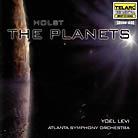 Holst - The Planets

![[Reviewed on CD]](../format/regcd.gif) Holst's
The Planets is, without a shadow of a doubt, his most popular work. Indeed, it is
arguably his only genuinely popular piece. The work has always been fortunate on record:
the first recording, under the direction of the composer himself, was made piecemeal
between September 1922 and February 1924, using the acoustic process. A subsequent
electric remake in 1926 was arguably done too soon in the life of the technology and,
against the odds, the earlier recording is both artistically and sonically preferable.
Holst's
The Planets is, without a shadow of a doubt, his most popular work. Indeed, it is
arguably his only genuinely popular piece. The work has always been fortunate on record:
the first recording, under the direction of the composer himself, was made piecemeal
between September 1922 and February 1924, using the acoustic process. A subsequent
electric remake in 1926 was arguably done too soon in the life of the technology and,
against the odds, the earlier recording is both artistically and sonically preferable.