Note: measurements taken in the anechoic chamber at Canada’s National Research Council can be found through this link.
 When I reviewed Arendal Sound’s 1528 Tower 8 in December 2024, I came away deeply impressed—not only by the speaker’s sound quality, but also by the sheer ambition of the product itself. The 1528 Tower 8 is unapologetically large, strikingly attractive, and capable of sounding both immensely powerful and exquisitely refined. At the time, it sold for $9500 per pair in the United States, and I called it a “monumental value.” Today it lists for US$10,900 per pair, and I still feel the same way.
But even as I praised the 1528 Tower 8, I recognized that its size would make it impractical for many listeners. In my review, I described the speaker as dominating a room physically as much as sonically—and I meant it. Standing 56.3″ high with its feet installed, weighing 174 pounds, and employing four 8″ woofers per speaker in a massive HDF-based enclosure, the 1528 Tower 8 is not a speaker you casually integrate into an ordinary living space. Although the pair worked well enough in my living room, which measures 16′W × 18′L × 8′H, they were ultimately better suited to my main listening room, which offers roughly the same listening-area dimensions but opens into substantially more space behind the listening seats.
Which brings me to the Arendal 1610 Tower 8. Just as the 1528 Tower 8 is the flagship floorstander in the 1528 series, the 1610 Tower 8 is the top model in the 1610 lineup, sitting above the 1610 Bookshelf 8, Slim 8, and Center 8 in both size and price.
Description
At $7600 per pair in the US, with all taxes and duties included (CA$11,100, £5900, and €6900 per pair in Canada, the United Kingdom, and Germany, respectively; check the company website for pricing and terms in other countries), the 1610 Tower 8 occupies a more approachable position in Arendal’s lineup in both size and price—a point I’ll address first.
Besides the 1528 Tower 8, we’ve reviewed three other Arendal Sound speakers—the 1528 Monitor 8, 1723 Tower THX, and 1723 Tower S—and found all of them to offer excellent value. One way the company provides such value is by designing in Norway but manufacturing in China. Another is by selling direct to consumers with a price that typically includes shipping, duties, and taxes to most countries. This approach cuts out dealers and distributors, which has both advantages and disadvantages. The biggest advantage is overall lower pricing, since there are no middlemen taking margins along the way. The biggest downside is that potential customers can’t audition the speakers at a dealer or rely on local dealer support and service.
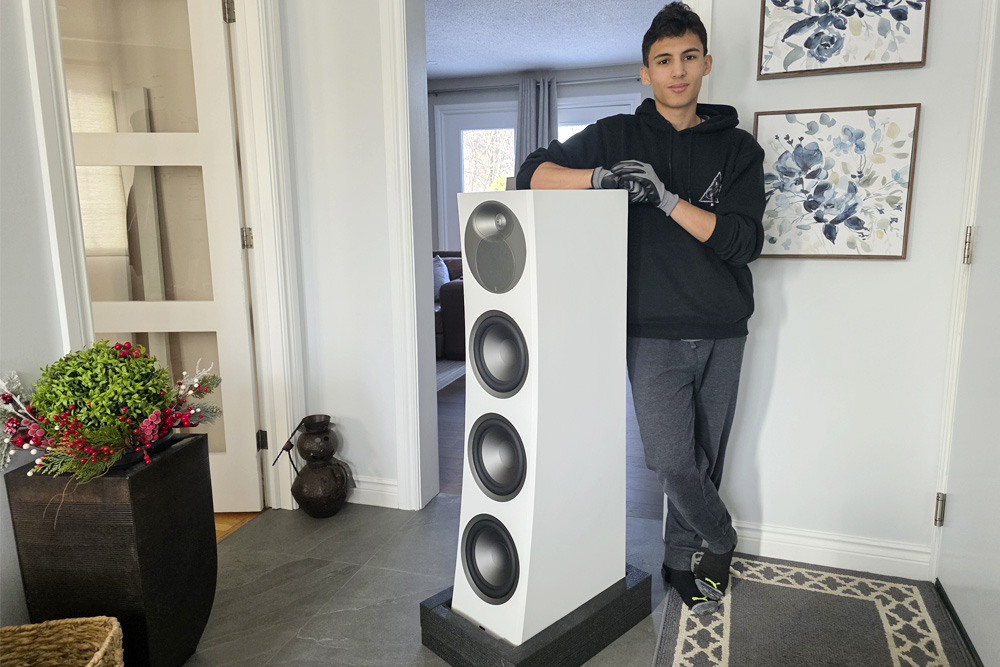 The author’s son helping to unbox Arendal Sound’s 1610 Tower 8
To offset the downsides, Arendal offers a 60-day in-home trial period, allowing customers to return the speakers if they’re not satisfied. (Depending on the country, there may be a return fee, so check the details with Arendal Sound.) Arendal also backs its speakers with a ten-year warranty—longer than what most manufacturers provide—and has earned a strong reputation for responsive phone and email support. Of course, implementing these policies costs money, so some of the savings from cutting out middlemen inevitably gets redirected into customer support and warranty coverage. It also costs Arendal quite a bit of money to ship the speakers—and from what I can tell, they do it well. All four speaker pairs we’ve reviewed (including this model) have landed on my driveway without fees, issues, or damage. Obviously that doesn’t mean everyone in the world will have this experience, but I wanted to tell you mine.
Now, about the 1610 Tower 8 itself. Like the 1528 Tower 8, it’s a three-way floorstander built around custom drivers and HDF cabinetry with a curved front baffle. The 1610 Tower 8 stands just over 47″ high with its feet attached and weighs 100 pounds. Seeing the two models in my house, the 1610 Tower 8 struck me as way more practical because of its more room-friendly size.
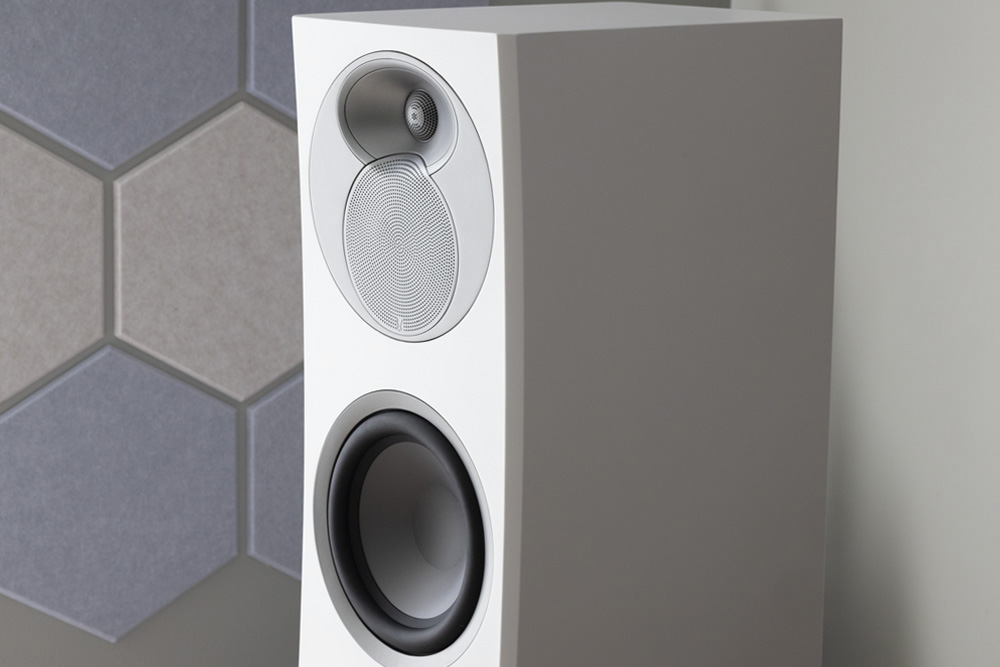
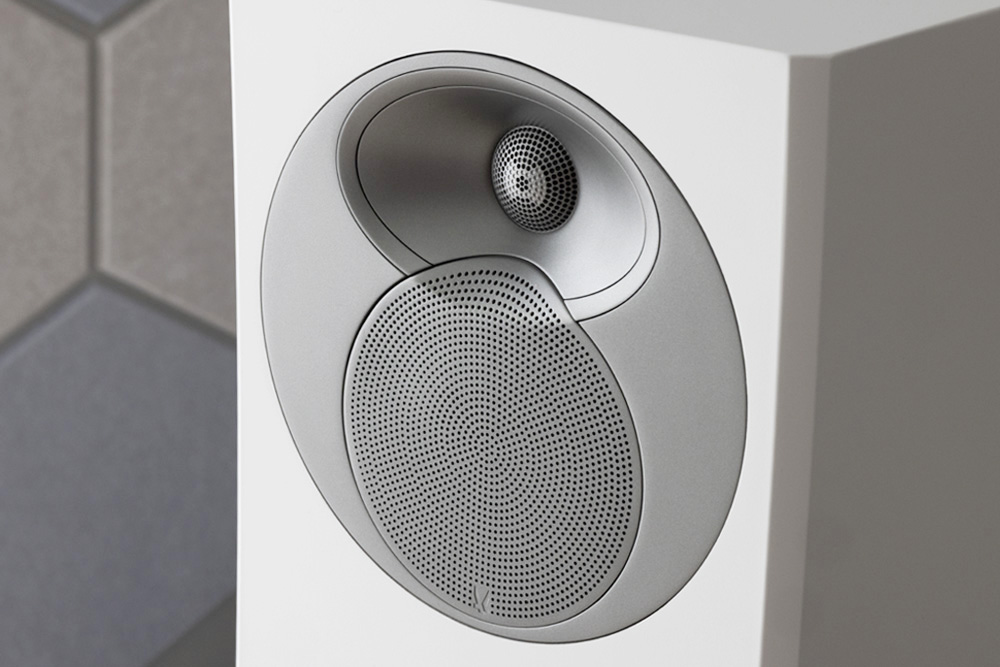
The driver complement also follows the same philosophy as the 1528, though to be clear, these are not the same drivers used in the 1528 Tower 8; they are, however, designed and built along similar lines. The 1610 Tower 8 uses a 28mm lithium-magnesium-dome tweeter paired with a dedicated 5″ carbon-cone midrange driver, both mounted in a sculpted assembly that closely integrates the two units. The tweeter sits within an elliptical waveguide and is protected by a metal grille that also has a phase plug to improve dispersion. The midrange is covered by a perforated plate.
Bass duties are handled by three 8″ aluminum-cone woofers with high-excursion motor systems—the 1528 Tower 8 has four 8″ woofers. Augmenting the bass is a bottom-firing port about 4″ in diameter and with strategically placed holes in its tube to reduce turbulence and noise. A foam port plug is supplied to partially block the port if its bass output overwhelms a room. Because the port fires downwards, it’s imperative to attach the metal outriggers and chunky rubber feet to give the port the clearance it needs. Arendal supplies two sets of sliders with each speaker—one for hardwood floors, the other for carpets—to help move the speaker around more easily.
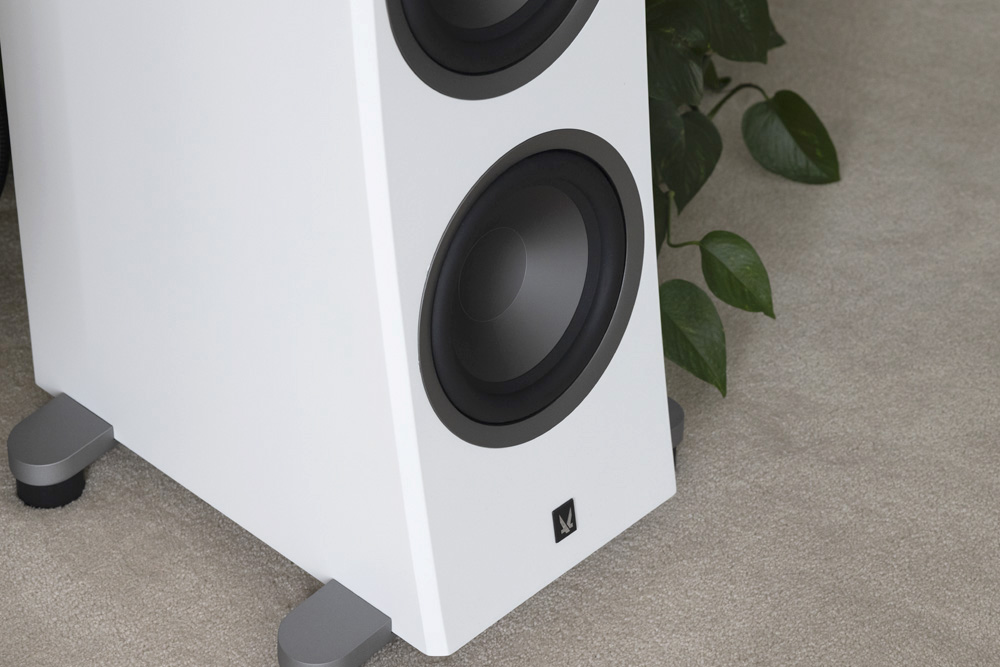
Unlike the tweeter and midrange, which have permanently affixed barriers to protect them, the woofers can be left exposed, or each can be covered individually with a magnetically attached grille. Three grilles obviously come with each speaker. It’s the same way with the 1528 Tower 8, but unlike that speaker’s four grilles, with each being a hard, flat, perforated disc on what feels like a hard-rubber frame, the 1610 Tower 8’s grilles are each a cloth dome over a skeletal plastic frame. The 1528 Tower 8’s grille is sturdier, but for me it’s a toss-up which looks better.
All five drivers are mounted on the curved front baffle, with the woofers crossing over to the midrange at 380Hz and the midrange to the tweeter at 2.6kHz. That curved baffle wasn’t part of Arendal’s earliest speaker designs, but it became a defining element of the 1528 series, which came before the 1610 series. However, on the 1528 models, the front baffle is visually separated from the rest of the cabinet by a black HDF layer that creates the illusion of the baffle floating in front. To me, that looks a little better than the curvature on the 1610 cabinet, but cost constraints ruled that out for this line.
Even so, designer Thomas Gunvaldsen stressed to me that the 1610 series is built to the same quality standards as the 1528 series, and that certainly tracked with my impressions. For instance, a quick knuckle-rap on the cabinet revealed the same dense, inert feel I’ve experienced with every Arendal speaker that has passed through here. The rest of the speaker parts seem to be of very high quality, too.
Like the 1528 series, the 1610 is available in two matte finishes: a dark gray called Basalt and a white called Polar, which is what my review pair came in. I like both finishes, and I also think the compact proportions of the 1610 are, visually, just right. But whether you think the 1610 Tower 8 looks better than, say, the high-style Sonus Faber Sonetto V G2 (US$7000 per pair) or the Estelon Aura (US$25,900 to US$33,800 per pair, depending on finish), both of which I’ve written about in the past, will be a personal choice. I like all three designs, each for a different reason.
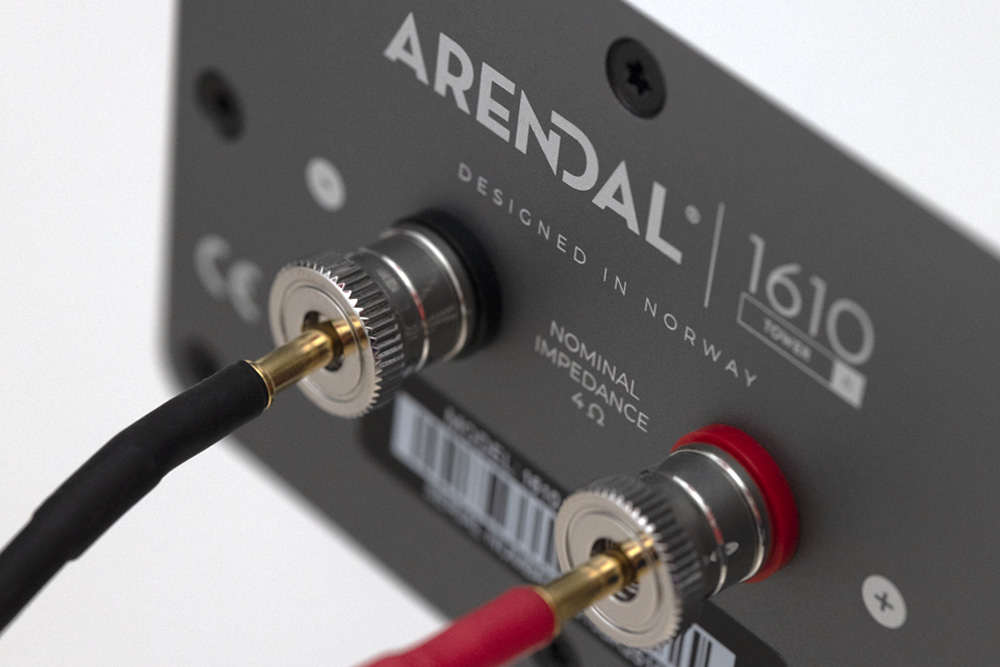
Unlike the 1528 Tower 8, the 1610 Tower 8 does not provide dual binding posts for biwiring or biamping, nor does it include the bigger sibling’s adjustable jumpers that allow users to tailor both the midrange and high-frequency output by ±2dB from the default Ref position. Instead, the backside has a single set of good-quality binding posts, and that’s all.
Arendal Sound rates the 1610 Tower 8’s anechoic bass extension at 28Hz (-6dB), sensitivity at 89.5dB (2.83V/m), and impedance at a nominal 4 ohms. In practical terms, that means you’ll want an amplifier comfortable driving a 4-ohm load and capable of supplying decent current, but not necessarily one with a massive power rating. As you’ll read below, I used the 1610 Tower 8s successfully with moderately powered integrated amplifiers.
Living-room sound
As I explained last month in my review of the SV‑Audio Frida loudspeaker, it’s often instructive to review speakers in more than one room, since the way a speaker interacts with a room is a major determinant of sound quality. And as I wrote in April in my review of Simaudio’s Moon 371 integrated amplifier, I evaluated that amp with both the 1528 Tower 8 and 1610 Tower 8 speakers, though with the 1528s it was in my reference listening room and with the 1610s it was in my living room. I never hauled the 1528 Tower 8s from my reference listening room back down to my living room to compare them to the 1610 Tower 8s, because they’re way too big and heavy.
In my living-room setup, the speakers were about 9′ apart, tweeter to tweeter, and about 1.5′ from the wall behind. In addition to the Moon 371 integrated amplifier, the system included a Denon DP‑3000NE turntable fitted with a Denon DL‑103o cartridge, which was connected to the amp’s phono stage with the stock Denon phono cable. Inexpensive QED XT25 speaker cables attached the amplifier to the speakers. The turntable and amplifier were plugged into a Shunyata Research Venom PS8 power distributor using their stock power cables, while the distributor itself was connected to the wall with a Shunyata Research Venom HC power cable. By audiophile standards, this was a straightforward system.
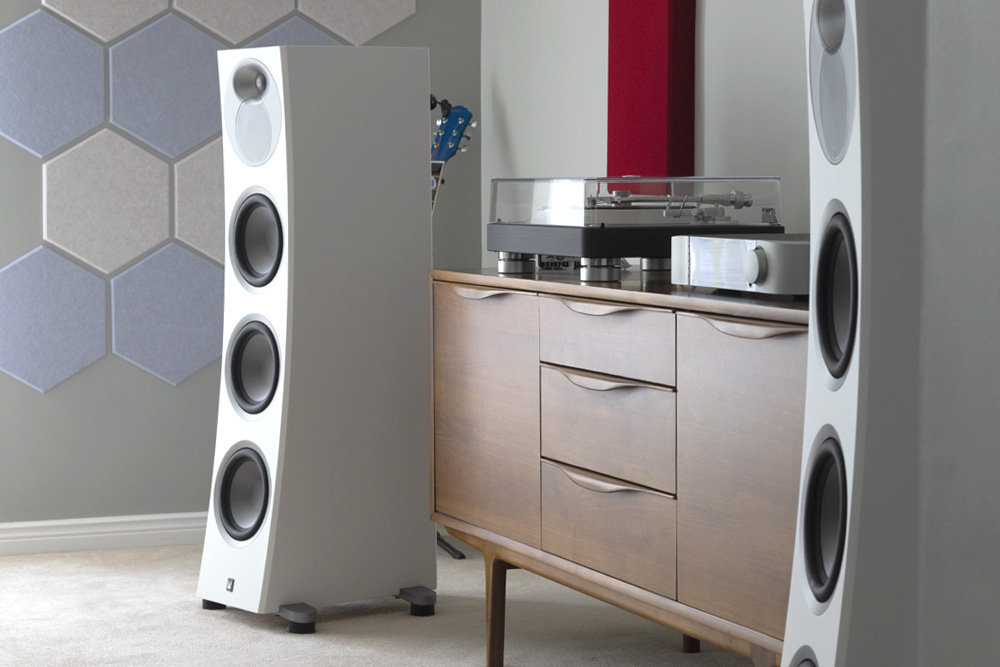
The 1528 Tower 8s worked well sonically in my living room when I had them there, but their size made them too visually dominant. In contrast, the 1610 Tower 8s were a much better fit, so even if cost weren’t a factor, I’d choose the 1610 Tower 8s for this room.
I’d also do that because their sound in my living room was reminiscent of the 1528 Tower 8s’. The 1610 Tower 8s sounded just as neutral in this space as the 1528 Tower 8s had (with their jumpers set to Ref, which is how I almost always ran them during and after the review period). But that’s not to say either Arendal speaker is as ruler-flat neutral as, say, a Revel Salon2, a pair of which I keep around for reference. Based on my listening, both Arendals have a touch more presence through the midrange than the Salon2. I like that subtle voicing because it pushes vocals slightly forward without sounding unnatural, not unlike what I’ve heard from many Focal speaker models, too.
Bruce Cockburn’s “Pacing the Cage” from The Charity of Night (16‑bit/44.1kHz FLAC, True North Records) is one of my go-to tracks for evaluating vocal quality. Through both pairs of Arendals, Cockburn’s voice projected into the room in a way I found highly engaging, while remaining extremely clear and intelligible.
The 1610 Tower 8s also reproduced the jangly opening instrumental textures on Emmylou Harris’s “Orphan Girl” from Wrecking Ball (Deluxe Edition) (24/44.1 FLAC, Nonesuch Records)—reportedly Daniel Lanois playing dulcimer alongside Malcolm Burn on tambourine, all wrapped in Lanois’s richly atmospheric production style—with the same clarity as the 1528 Tower 8s did. The 1610s sounded just as dynamic with this song, and they could play every bit as loudly as I wanted, even driven only by the Moon 371. (The 371 is rated at more than 100Wpc into 8 ohms and 200Wpc into 4 ohms, and it exceeded those figures in our lab measurements.)
But on the Emmylou Harris track and others with a slightly brighter tonal balance—Lana Del Rey’s “White Dress” from Chemtrails over the Country Club (16/44.1 FLAC, Interscope Records / Qobuz), for example, because it’s wispy as hell—I noticed an interesting difference between the two Arendal models. With the 1528 Tower 8s, I occasionally felt tempted to switch the high-frequency jumpers on each speaker from Ref to Lo, which reduces the treble output by 2dB. With the jumperless 1610 Tower 8s, however, the highs remained prominent without ever sounding overbearing. Their tonal balance consistently struck me as just right in my room, which suggests to me that Thomas Gunvaldsen voiced this newer speaker to avoid any perception of brightness from the outset.
However, one place the 1610 Tower 8s could not match the 1528 Tower 8s in this room was in the very deep bass. As I said, I didn’t have the two models side by side for direct comparison, but I clearly remember the 1528 Tower 8s reaching lower on tracks such as Cowboy Junkies’ “Mining for Gold” and “Misguided Angel” from The Trinity Session (16/44.1 FLAC, RCA Records). These tracks pressurized the room through the 1528s in a way the 1610s simply could not duplicate. Best as I could tell, the 1610 Tower 8s delivered clean, powerful bass into roughly the lower-30Hz range in my room, but the 1528 Tower 8s sounded meaningfully deeper and more authoritative below 30Hz, with greater weight, scale, and sense of ease. That said, the 1610 Tower 8s played deeper bass than the Sonetto V G2 and Estelon Aura loudspeakers did in this room.
As well, the 1610 Tower 8s weren’t quite as effortless-sounding as the 1528 Tower 8s were in my living room or my reference listening room, though they were close. Whenever I was listening to the 1528 Tower 8s, music just flowed from them at low to high volume levels like they weren’t even trying—like they were coasting, akin to having an oversized engine in a car. The 1610 Tower 8s sounded at ease reproducing every kind of music I threw at them from low to very high volume levels, but it just didn’t seem quite as easy. Admittedly, it’s a hard thing to understand until you hear it. That said, no other floorstanders that have been in this living-room space—including the Sonetto V G2s and Estelon Auras—have sounded as effortless at the 1528 Tower 8s. And a little speaker like the SV‑Audio Frida is a big step back in that regard due to its small size and limited output capability. I can’t say definitively why the 1528 Tower 8 embodies this quality so well, but if I had to guess, I’d say its four sizeable woofers and very large cabinet have a lot to do with it.
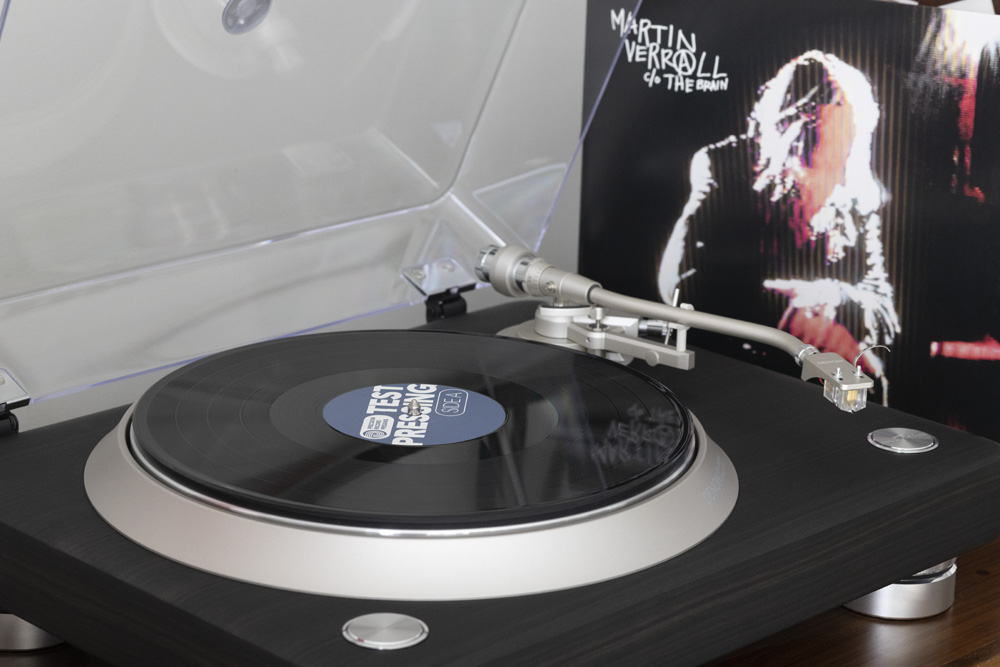
Top-to-bottom clarity is another standout trait of the 1610 Tower 8, just as it is with the 1528 Tower 8. As I wrote in my review of the Moon 371, referring to the system that included the 1610 Tower 8s: “My vinyl auditioning included evaluating the test pressing of Martin Verrall’s C/O the Brain (SRMH 001)—the first release under our SoundStage! Recordings label—before it went to final production. As a result, this system served as an evaluation tool not only to determine whether the tonal characteristics of the original recording had transferred successfully to the vinyl, but also to detect any pressing flaws, so the resolution had to be there. In short, I trusted what I could hear from it.”
The reason I trusted that system so much was the transparency of both the Moon 371 and the speakers attached to it. The 1610 Tower 8s let me hear everything embedded in that recording as I repeatedly played the test pressing evaluating faithfulness to the master tape and listening for any pressing flaws. And even if the 1610s couldn’t quite reach as deep into the bass as the 1528 Tower 8s, bass was never lacking. All told, by the end of that process, I had little doubt that, for music playback, the 1610 Tower 8 is a superb loudspeaker—and I could’ve recommended it just based on that.
Media-room sound
But that wasn’t all. Because Arendal also markets its speakers for home-theater use, I moved the 1610 Tower 8s into our media room, which has a large-screen TV and gaming setup. The room is irregularly shaped and fairly large—about 13′ × 22′. We sit on a sofa along one of the long walls opposite the TV, roughly ten feet away.
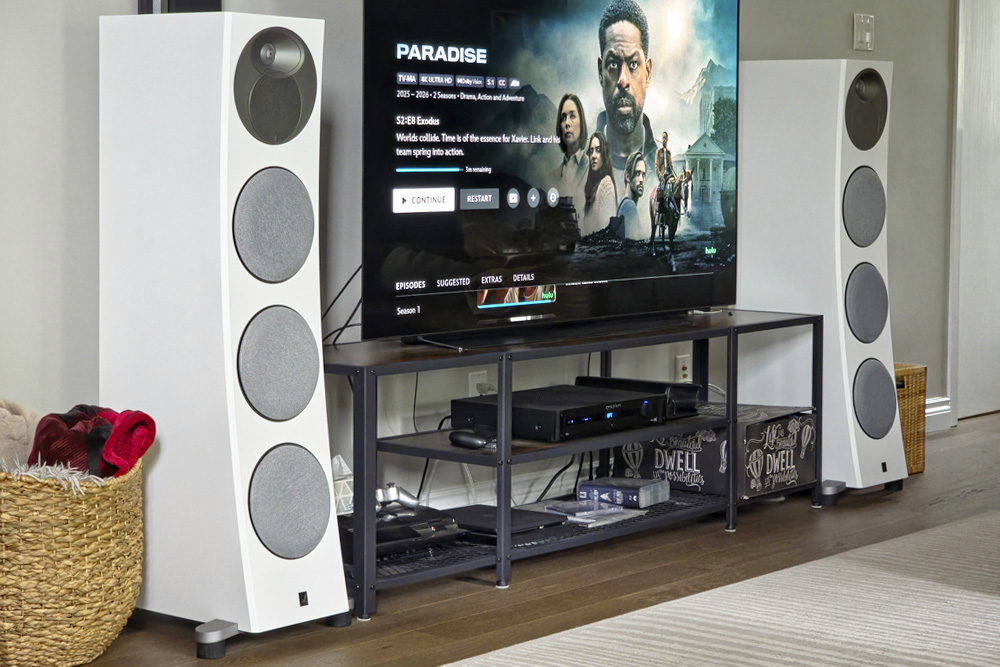
I don’t use a full surround-sound system in this room—and that’s intentional, because I don’t want speakers scattered around the space for people to bump into or tip over. Also, I don’t watch with or expect high-volume sound in this space, so it’s far from one of those super-high-output home-theater setups. Normally, I use a pair of in-wall/on-wall Axiom Audio W22 speakers mounted around the TV. Power comes from an Emotiva BasX TA1 stereo receiver, which, at US$499, is a steal and entirely adequate for my needs. Mind you, it’s far from an ideal match for a pair of 1610 Tower 8s. Rated at 60Wpc into 8 ohms or 100Wpc into 4 ohms, the TA1 can drive the speakers to sensible listening levels, but not close to their full potential. For serious listening, I’d consider something along the lines of the Moon 371 a more appropriate minimum for power. Another pair of QED XT25 speaker cables connected the speakers to the amplifier.
An important point about this setup is that I couldn’t realistically have used the 1528 Tower 8s in this room for any length of time because they would have protruded far too much into the space. At nearly 22″ deep, the 1528 Tower 8 is about 6″ deeper than the 1610 Tower 8, which matters when you consider I already had to position the 1610s within inches of the wall to allow people to pass by comfortably. Once again, the smaller Arendal design proved advantageous.
But the downside to placing the speakers so close to the rear wall was reinforced bass, which could occasionally sound a little plump depending on the material. I briefly considered plugging the ports, but in practice the plumpness never bothered me enough to do this. Instead, what stood out was how much more life the speakers brought to well-recorded movie and TV soundtracks, along with how clearly they reproduced voices—especially important without a dedicated center-channel speaker.
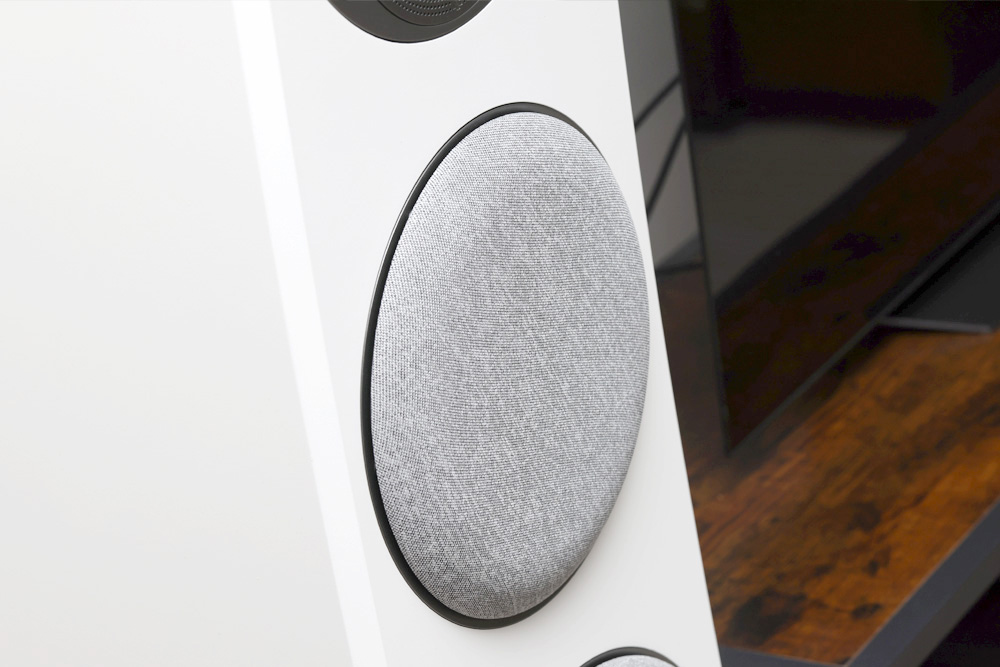
My wife and I watched a few movies and several TV programs. Most memorable were the first two—and currently only—seasons of Paradise, a series both well recorded and heavily dialogue-driven. Voice clarity through the 1610 Tower 8s was excellent, aided by the speaker’s subtle midrange presence and what I suspect is very low distortion throughout the region to allow for that cleanliness of sound. Even more impressive was the music woven throughout the show: original songs along with numerous highly addictive cover versions were often mixed faintly into the background, encouraging you to listen closely.
That’s where the remarkably clear presentation of the 1610 Tower 8s really paid off. With lesser speakers in that room, hearing dialogue more clearly or picking up subtle background details usually meant reaching for the remote and turning up the volume. Through the 1610 Tower 8s, we could hear more without constantly adjusting levels.
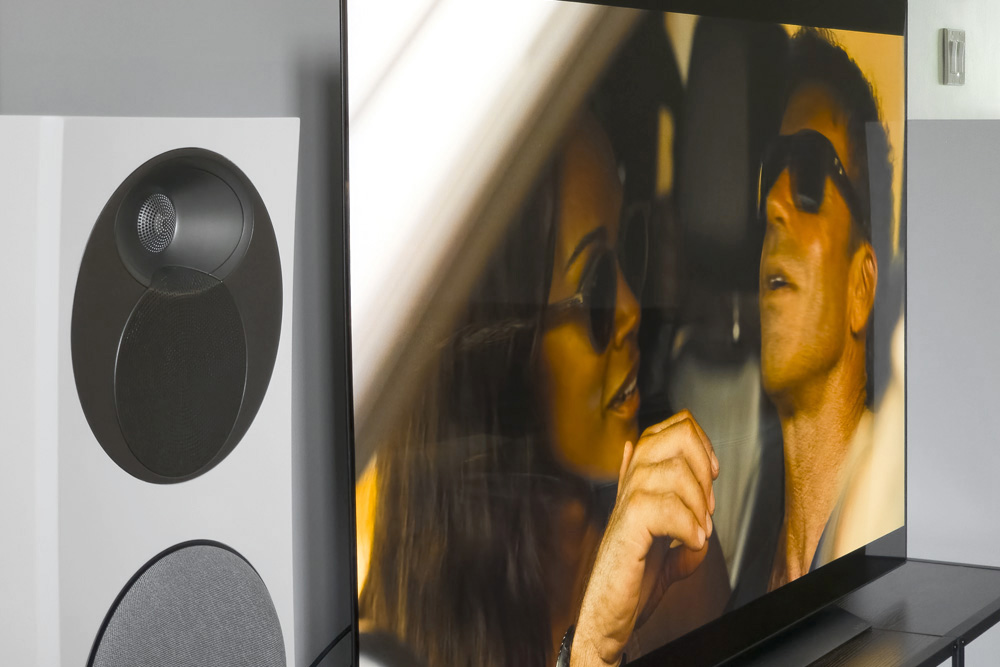
On more bombastic material—the series Lioness, for example—the 1610 Tower 8s again delivered, reproducing not only dialogue convincingly but also gunfire, explosions, punches, and every other form of mayhem with satisfying bass weight and high clarity across the audioband. Mind you, we weren’t playing anything particularly loud. Doing that properly would have required a far more powerful amplifier than the TA1. But for our straightforward use case, this relatively affordable and décor-friendly setup worked remarkably well.
Conclusion
Although I speak enthusiastically about Arendal Sound and its products today, it took several years for me to get there. When we received our first Arendal speaker to review, the 1723 Tower S, I admired its build quality and aggressive pricing, but because reviewer Philip Beaudette found the sound very good rather than truly great, I wasn’t yet convinced the company was producing world-class loudspeakers. I saw it instead as a promising start.
That changed when the 1528 series arrived and I reviewed the Tower 8. I not only raved about that speaker—I also hopped on a plane with our video crew to learn more about the company firsthand. During that trip, designer Thomas Gunvaldsen impressed me with both his technical skill and clear understanding of loudspeaker design, while owner Jan Ove Lassesen struck me as forthright and determined to deliver high performance with equally high value to consumers.
Since then, my respect for the brand has only grown. Philip subsequently reviewed and loved the 1528 Monitor 8s enough to consider buying them. But after auditioning the 1528 Tower 8s I reviewed, he instead purchased that exact pair—they’re now his reference speakers. As for me, I wasn’t happy to see those Tower 8s leave, because they sounded that good, but the 1610 Tower 8s came surprisingly close to filling that void.
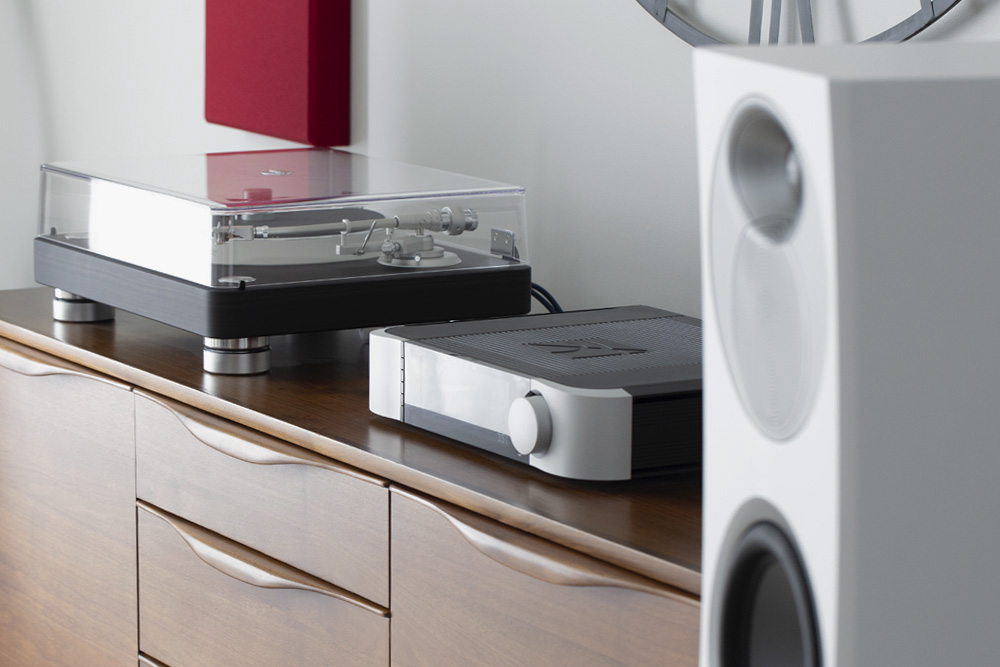
The 1610 Tower 8 delivers most of the performance of the 1528 Tower 8—perhaps 90 percent, for the sake of perspective—at just over two-thirds the price and in a considerably smaller, more room-friendly package. It doesn’t produce bass quite as deep, nor does it sound quite as effortless as its bigger sibling, but it retains the qualities that made the 1528 Tower 8 so compelling in the first place: general neutrality, exceptional clarity, strong dynamics, pretty much full-range sound, and an ability to play very loud but also very soft equally well.
More importantly, the 1610 Tower 8 is a more practical speaker for many real-world rooms and systems. In my case, the pair worked well in my living room as well as in my media room, the latter being a place where the 1528 Tower 8s would’ve made no sense.
In sum, I wouldn’t call the 1610 Tower 8 a “monumental value” in quite the same way I described the 1528 Tower 8, because the bigger speaker remains the more ambitious product overall. But I would call the 1610 Tower 8 the sweet spot in Arendal’s lineup—I think many will still aspire to the 1528 Tower 8, but when considering performance, size, and price, I think this is the model more people will—and probably should—buy.
. . . Doug Schneider
das@soundstage.com
Associated Equipment
- Loudspeakers: Arendal Sound 1528 Tower 8, SV‑Audio Frida
- Turntable: Denon DP‑3000NE turntable with Denon DL‑103o cartridge
- Integrated amplifiers: Simaudio Moon 371, Emotiva BasX TA1
- Speaker cables: QED XT25
- Phono cable: Denon
- Power cords: Shunyata Research Venom HC
- Power distributor: Shunyata Research PS8
- Acoustical treatments: BXI Sound Absorber panels (20), Tönnen Sound panels (2)
Arendal Sound 1610 Tower 8 loudspeaker
Price: US$7600, CA$11,100, £5900, €6900 (in Germany; for prices in other countries, check the company’s website). All prices are per pair, and include shipping, sales taxes, and import duties.
Warranty: Ten years, parts and labor
Arendal Sound
Industritoppen 6C
4848 Arendal
Norway
Website: www.arendalsound.com