I am writing this editorial shortly after returning from England, where our chief videographer, Chris Chitaroni, and I visited two audio companies. One of these companies, Monitor Audio, has a long history dating back more than 50 years. The other, Node Audio, is less than ten years old. I first learned about them in 2018.
Arrival in Rayleigh
Chris and I arrived at the headquarters of Monitor Audio Group in Rayleigh, Essex, on March 9 and stayed through March 10. Monitor Audio Group comprises Monitor Audio, founded in 1972 as a loudspeaker manufacturer, and two other UK brands the company acquired in 2016 and 2019, respectively: Roksan, known for turntables and electronics, and Blok, which produces hi‑fi furniture such as equipment stands. It’s a significant operation in England with over 60 staff.
Most of Monitor Audio’s speakers are made in China, but the flagship Hyphn is made in the Rayleigh facility. Roksan’s products are made in England, too. Blok products are made in China.

During our visit, we shot a product video for our YouTube channel. But our primary reason for being there was the launch of the new Monitor Audio Experience Centre. The facility occupies a space that previously housed the company’s loudspeaker R&D team, which has since moved into a neighboring building that’s also part of the headquarters. The celebratory opening attracted nearly 100 attendees, including members of the UK press, dealers, distributors, and even the local mayor. It was clearly an important milestone for the company—and we captured the proceedings for an upcoming video.
Inside the Monitor Audio Experience Centre
The concept of the “experience center” (or “centre,” depending on which dictionary you’re consulting) has become common in the audio industry. Some of these facilities are little more than a single demonstration room. But Monitor Audio Group’s implementation is far more substantial and purposeful than most. Upon entering, visitors encounter a welcoming bar and lounge area. To the left is a large, open demonstration space that, during our visit, featured various types of Monitor Audio loudspeakers positioned along three walls and a stack of Roksan electronics in one corner.
 Inside the custom-install listening room
At one end of this space is a door to a living‑room‑style listening area showcasing Monitor Audio’s in‑wall and on‑wall loudspeakers, along with compact subwoofers on the floor. I did not note the exact model designations for the on- and in-wall products, but based on the demonstration and the company’s current lineup, the system probably included MA’s Creator-series architecture loudspeakers powered by its custom‑installation amplifiers—another category the brand has expanded into in recent years.
I spent some time listening in this room and was struck by how convincing the presentation was. The sound quality rivaled what I have heard from many conventional freestanding loudspeakers, underscoring just how far architectural-loudspeaker design has progressed.
A hallway of history
Running alongside the large main room is a long hallway that functions as both a museum and a timeline. Vintage products from the three brands are displayed alongside archival photographs and magazine pages, documenting decades of development. As someone who appreciates learning the histories of successful businesses, I thoroughly enjoyed this exhibit, not just because it shows how these brands have evolved under the Monitor Audio Group umbrella, but because it also shows their legacies haven’t been forgotten—which often happens at companies of a certain age, especially when founding staff move on.
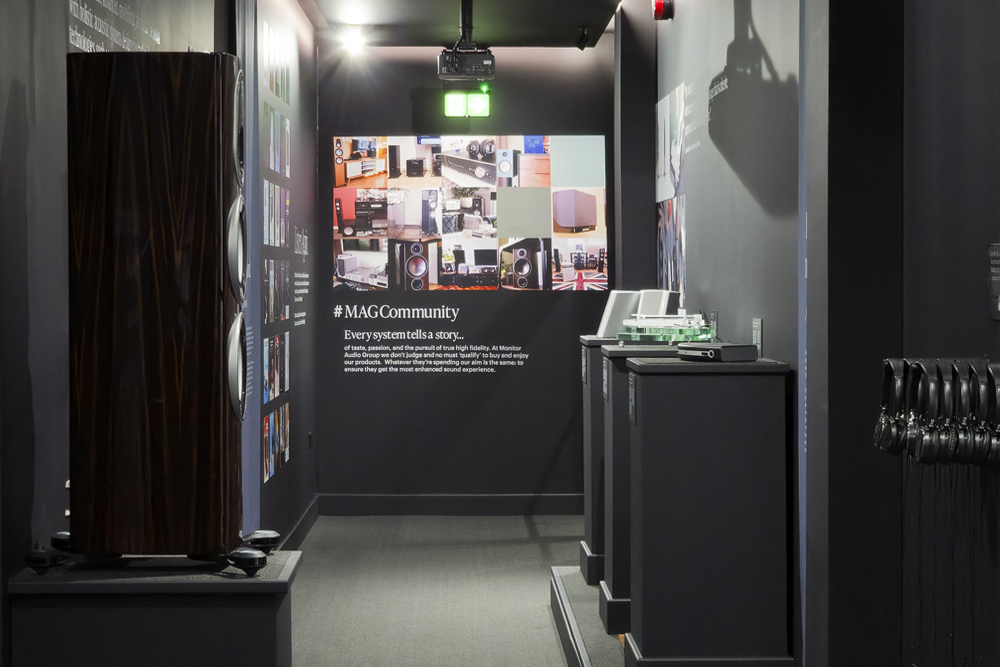 Museum of Monitor Audio Group history
Further evidence that the staff at Monitor Audio remember their roots is that key meeting areas around the headquarters have been named after influential employees, such as the Hartley Suite, named after former technical director Dean Hartley, who was attending the launch that day.
 Doug Schneider with former Monitor Audio Group technical director Dean Hartley at the Hartley Suite
Listening rooms
Off this corridor there are two additional listening spaces. One is another living‑room environment, which during the launch event housed the company’s Hyphn loudspeakers. I was told this room will serve as the primary showcase for Monitor Audio’s top‑tier products. Mainly for reasons of timing, I was not able to audition that system during my visit.
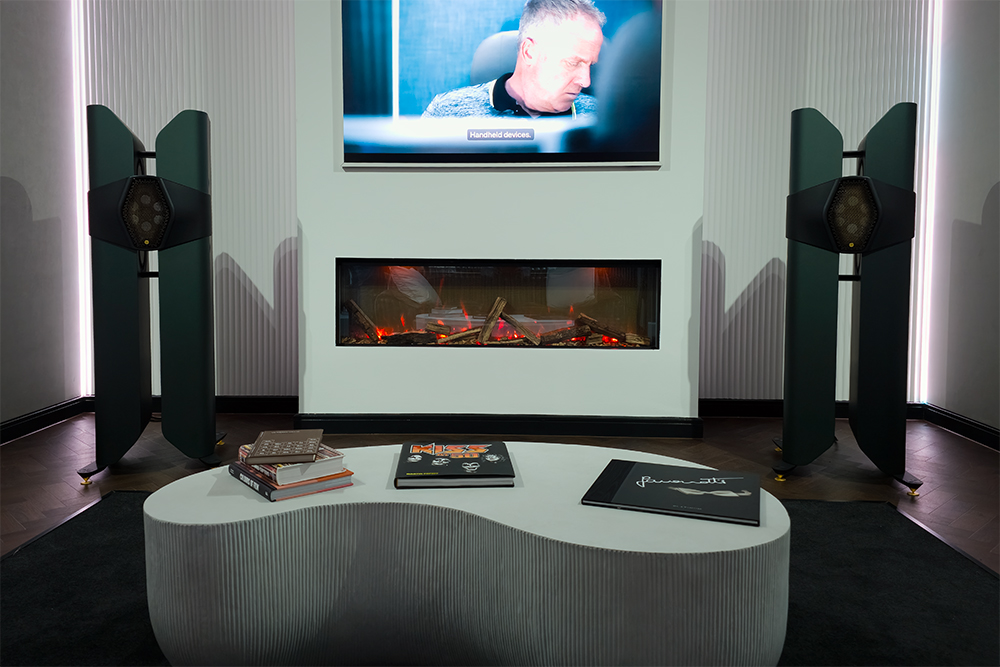 High-end listening room with Hyphns
However, I did some listening in the second room, and it proved visceral and exciting. Designed as a dedicated home‑theater environment with two rows of cinema‑style seating, it features a concealed installation of Monitor Audio Cinergy loudspeakers and multiple Cinergy subwoofers integrated into the walls. Those are staying put, because they’re behind acoustically transparent walls, and will likely only be changed when the models themselves are changed.
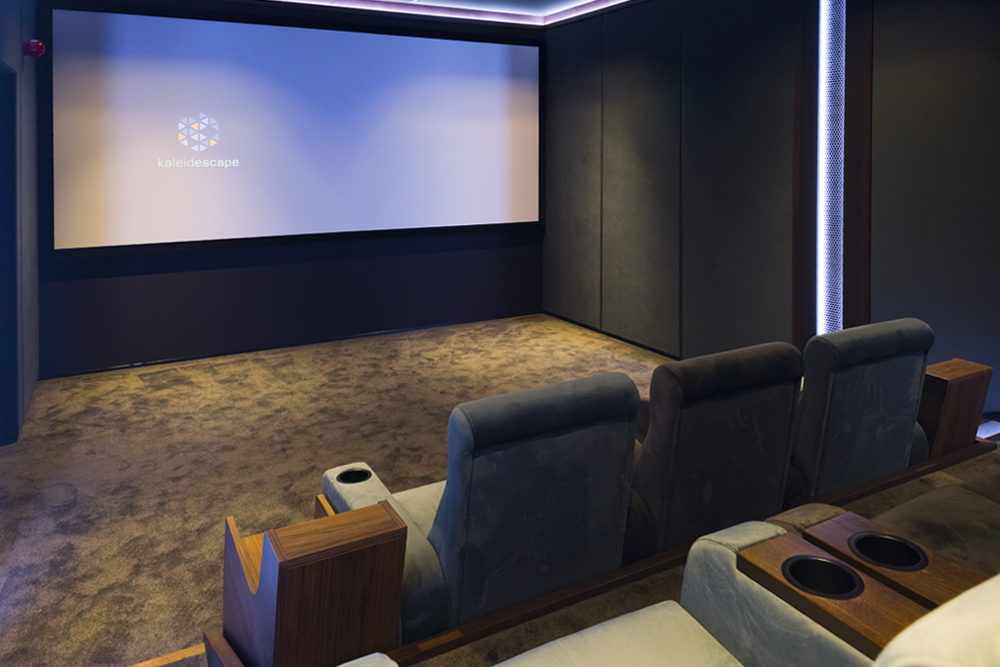 Home-theater room
The system was demonstrated by Michael Hedges, Monitor Audio Group’s technical director, who personally oversaw the acoustic design of the space. His demonstration included both music and film soundtracks. The performance impressed me—effortlessly powerful when required, yet clean, controlled, and genuinely full‑range. With multiple subwoofers in play, deep bass extension was a given, but what stood out most was the overall coherence, refinement, and clarity across the entire audioband. While I had long been aware that Monitor Audio offered serious custom‑installation products, experiencing this room firsthand made clear just how convincingly the company can compete at the higher end of the home‑theater market.
Education and distribution
The facility itself is impressive, but its intended purpose may be even more significant. Beyond showcasing products, the Monitor Audio Experience Centre is designed as an educational hub for dealers and distributors from around the world. Monitor Audio Group has developed an educational program called the Elevate Sound Performance Academy, offering training sessions not only on product features but also on best practices for installation and system integration. The goal is clear: improve the experience for end customers by ensuring systems are well understood, convincingly demonstrated, and correctly installed.
 Doug Schneider and Dean Hartley with current Monitor Audio Group technical director Michael Hedges
This emphasis on education reflects something broader about Monitor Audio Group’s business philosophy. The company continues to invest heavily in its traditional distribution network, working closely with retail partners on the hi‑fi side and professional installers in the custom‑integration market. And the scale of this investment suggests that Monitor Audio Group continues to see significant value in its specialist‑dealer and professional‑installer network, rather than focusing primarily on direct‑to‑consumer or mass online-retail channels.
High energy
While Monitor Audio is not a century‑old institution like Luxman—which celebrated its 100th anniversary last year—its five-decade-plus history places it firmly among the most established names not only in British hi‑fi, but internationally. What was especially refreshing during my visit was the palpable sense of enthusiasm within the company. There was an energy that felt closer to that of a startup than a mature manufacturer. Hedges spoke passionately about the engineering behind the products. Lead industrial designer Charles Minett showed equal excitement when discussing design direction. Other employees seemed jazzed, and former employees visiting were in awe of how the company has developed since its modest beginnings in 1972, when it was founded by Mo Iqbal.
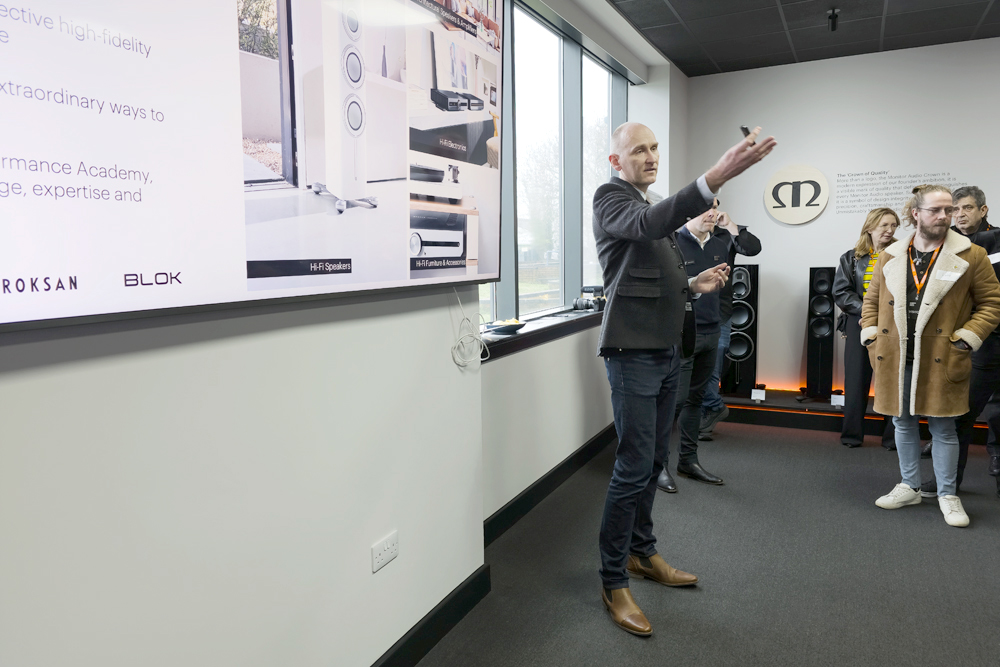 Monitor Audio Group CEO Robert Barford presenting
Perhaps most surprising was the visible enthusiasm of CEO Robert Barford. An accountant by training, Barford—thankfully—does not fit the stereotype of a numbers‑driven executive, who in some industries can prioritize cost control over product development. Instead, Barford spoke repeatedly about the importance of investing in innovation—an approach that helped bring ambitious products like the Hyphn loudspeaker to market and ultimately led to the creation of the Monitor Audio Experience Centre itself. At one point he summed up his philosophy simply, saying: “It’s great to be able to create products that people find fun.” After spending time at the facility and learning more about the company’s capabilities, it was difficult to disagree.
Node Audio: a smaller, newer, but ambitious operation
Before arriving in Rayleigh we’d spent a day in Cambridge, about 60 miles away, visiting Node Audio—which, in terms of size and history, is basically the antithesis of Monitor Audio Group. Its two founders, Ashley May and David Evans, are partners in Studio17 Design, an industrial-design firm also based in Cambridge. Node Audio offers four speaker products in total, across the Hylixa and Atom ranges. The company recently released the SS‑1 isolation footers, which we were told are selling well and helping the brand establish itself. But our focus was Node Audio’s speakers.
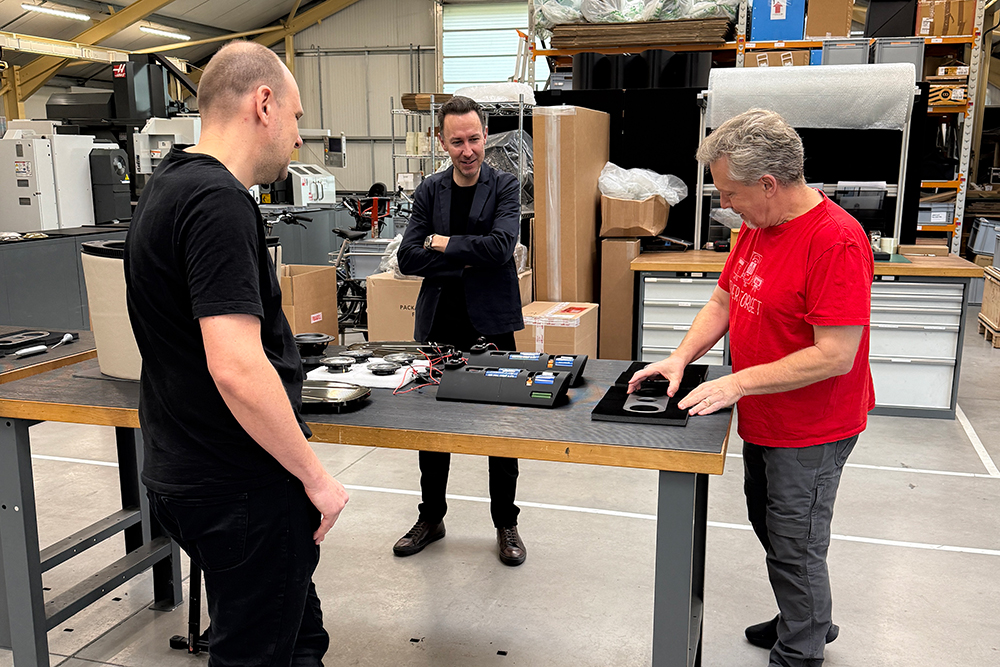 Node Audio cofounders Ashley May (left) and David Evans (center) watch as Doug Schneider examines speaker parts
Node Audio was born out of an original transmission-line idea that May had developed. The design was quite complex geometrically, but needed no internal stuffing to damp resonances. Once May verified that it could work by bringing in Christien Ellis, a Cambridge-based acoustical consultant who’d worked with other audio brands, he convinced Evans that they should create loudspeakers.
First the Hylixa . . .
It started with the Hylixa, which I first saw in 2018 at UK Hi‑Fi Show Live, held at Ascot Racecourse near London. I remember thinking that the Hylixa was a novel and potentially intriguing design—particularly the overall cabinet shape and the cutaway I saw of the complex cabinet geometry. But since the Hylixa never made its way across the Atlantic Ocean, I didn’t think about it much after that.
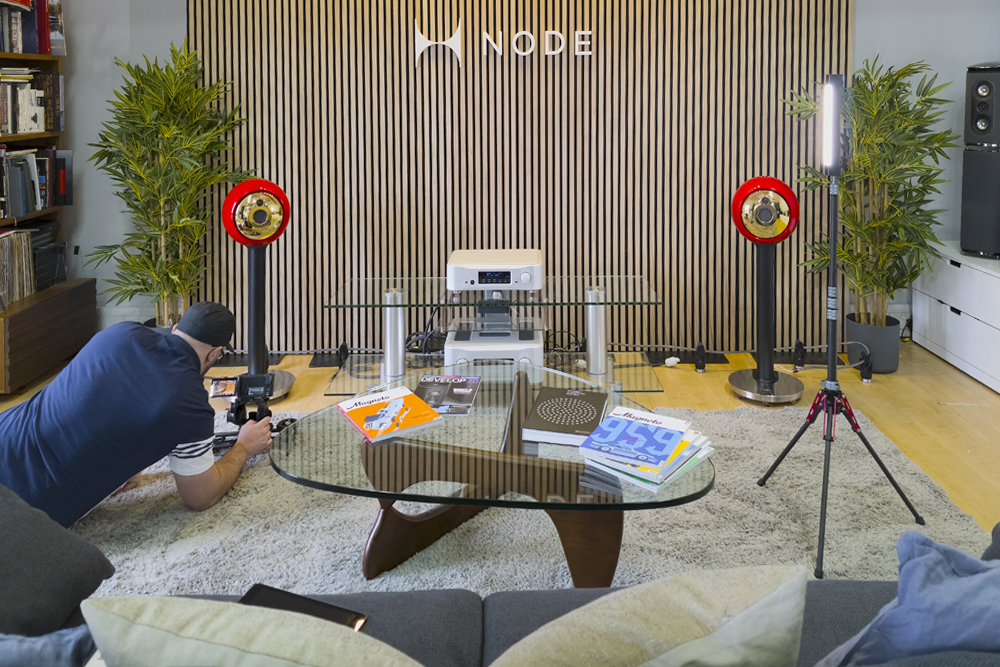 SoundStage! chief videographer Chris Chitaroni shooting a pair of Hylixa loudspeakers
The Hylixa has evolved since then, first becoming the Hylixa Signature, with upgraded crossover parts over the original design, and then morphing into two Signature models: the Authentic Edition (£34,000 per pair) and the Exclusive Edition (from £38,000 per pair). The Signature Authentic Edition comes in matte white or matte black, while the Signature Exclusive Edition comes in a host of shinier color finishes and can even be had with a 24K-gold front baffle, which is why the price is from £38,000.
Acoustically they’re the same, with a spherically shaped main cabinet that seems well-suited to avoiding diffraction issues. It’s propped up by an integral stand with a super-heavy solid-metal bottom plate. On the front, inside what almost looks like a floating circular baffle, is a 0.75″ ring-radiator tweeter and a 1.8″ balanced mode radiator (BMR) midrange driver. Internally there’s a 5.5″ woofer at the front end of a transmission line that cleverly snakes its way inside the cabinet and exits around that circular front baffle. When well implemented, a transmission line extends the bass response significantly, so the goal here was to create a small-ish, décor-friendly speaker that approaches full-range sound. Node Audio claims a -6dB point at 25Hz—an ambitious specification for a speaker of this size and one that would need to be confirmed in a controlled listening and measurement context.
. . . And then the Atom
As I said, Node Audio hadn’t been on my mind for a long time, but the company reappeared on my radar last year when they announced two lower-priced products—the Atom 525 and Atom 650, priced from £15,800 and £20,950 per pair, respectively, and from again because there are different finish options (the cabinet shroud can be either fabric or leather). The 525 is a standmount design, while the 650 is a floorstander. Both have three-way topologies with a 0.85″ soft-dome tweeter vertically flanked by two 2″ midrange drivers, each with a magnesium-alloy cone. The 650 has a 6.5″ internal woofer and the 525 a 5.25″ woofer, hence their names.
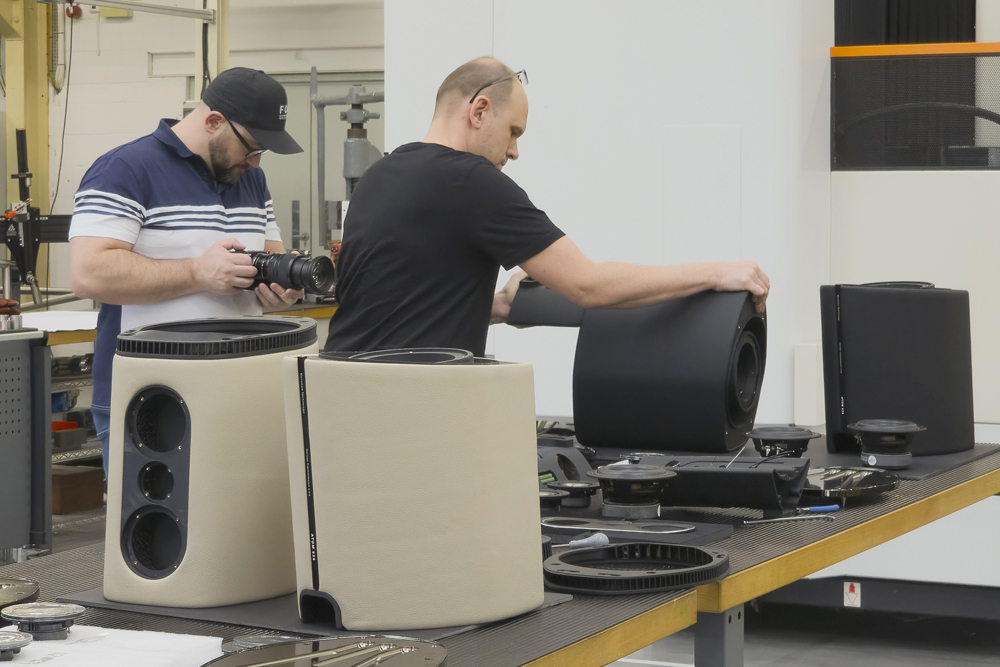 Ashley May showing how an Atom 525 loudspeaker is assembled
Both have cabinets more conventional-looking than the Hylixa design, but they’re still exotic-looking compared to most, particularly with their material cladding around the sides and their distinctive dome-shaped, vented tops. Fans of traditionally designed British hi-fi (think Harbeth or Spendor) might not like the looks of Node Audio’s speakers, but I think design-conscious people will appreciate them.
Like the Hylixa speakers, each Atom model has a bass-extending transmission line snaking through it, but instead of the vent being on the front baffle it’s at the top. And the Atom speakers incorporate an innovation that’s not part of the Hylixa models—something Node Audio calls MonoCell, which is a labyrinth of porous holes behind the midrange drivers used to damp the drivers’ backwave energy. Because of MonoCell, there is no stuffing in either Atom cabinet.
Additive manufacturing
While the distinctive transmission-line geometry and MonoCell structure can be considered among the company’s claims to fame, there is another important story here. It involves not only the cabinet materials—glass-filled nylon for the Hylixa models and polylactic acid (PLA) for the Atoms—but also the manufacturing processes used to shape them. These processes make it possible to realize the complex, snaking transmission lines and the intricate MonoCell architecture that define the designs.
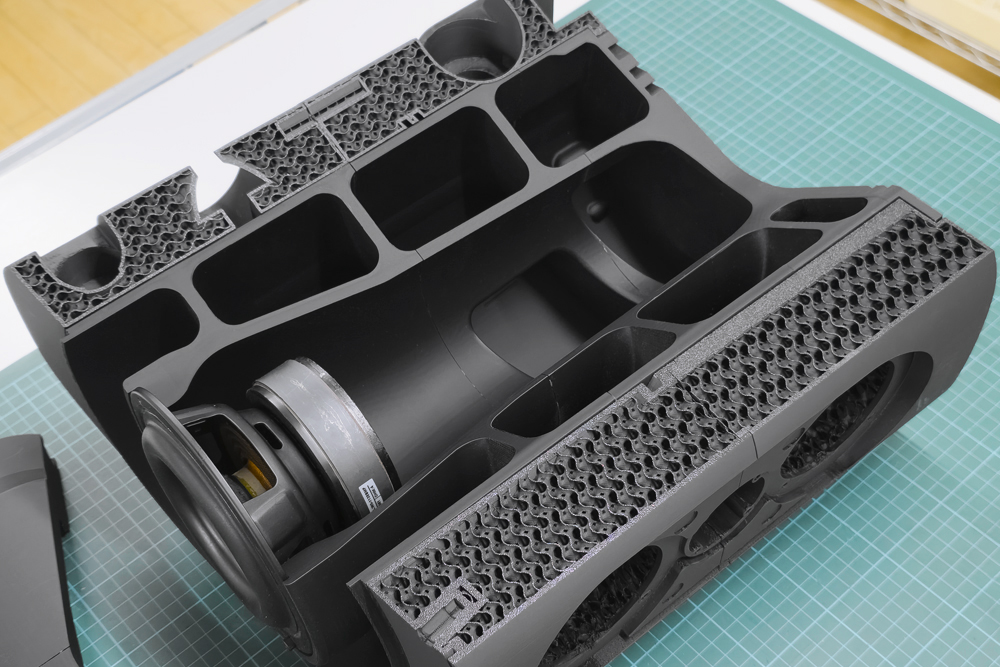 Inside a Node Audio Atom 525 loudspeaker
In broad terms, most people would simply call this 3D printing, though May and Evans are not fond of that label; they feel it evokes inexpensive consumer machines intended for home use, not the massive, expensive, industrial-grade machinery they use. Instead, they prefer more precise terms that fall under the umbrella of “additive manufacturing.” The Atom cabinets are produced using fused deposition modeling (FDM), while the Hylixa enclosures are created via selective laser sintering (SLS). Neither method is especially quick, with SLS being the slower—apparently, the main Hylixa cabinet can take upward of 45 hours to manufacture. According to May and Evans, additive manufacturing was the only way to realize these designs.
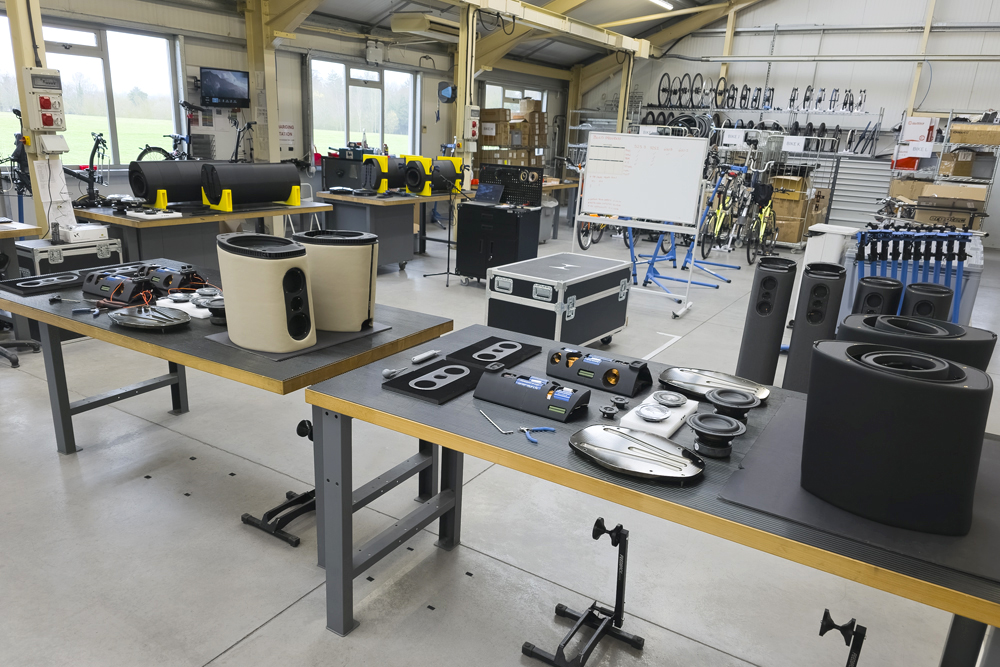 Where Node Audio speakers are made
All this work is done in a research park that hosts Node Audio along with other companies. There’s a vast amount of machinery in there, with some producing products completely unrelated to hi-fi, such as electric bicycles and collapsible mannequins. Node Audio’s drivers come from third-party vendors, and the painting is done externally. But along with the cabinet creation, all final assembly happens there in the factory, allowing Node Audio to declare that they’re not only made in England, but in Cambridge, which they regard as an important center for British hi-fi.
Future plans
Now, I know what many might be wondering: how do Node Audio’s speakers sound? I listened briefly to a pair of Hylixas pre-pandemic at Hi‑Fi Show Live and thought they sounded promising. But truth be told, I only gave them passing attention and can’t clearly remember their sonic character. Frankly, that tends to happen with new companies—they’re not given the attention from reviewers or consumers that they may deserve. Furthermore, during our visit we had just one day at the facility and spent much of it moving speakers around to film video footage. Before we knew it, the day was over and we had to leave for Rayleigh. There was just no time.
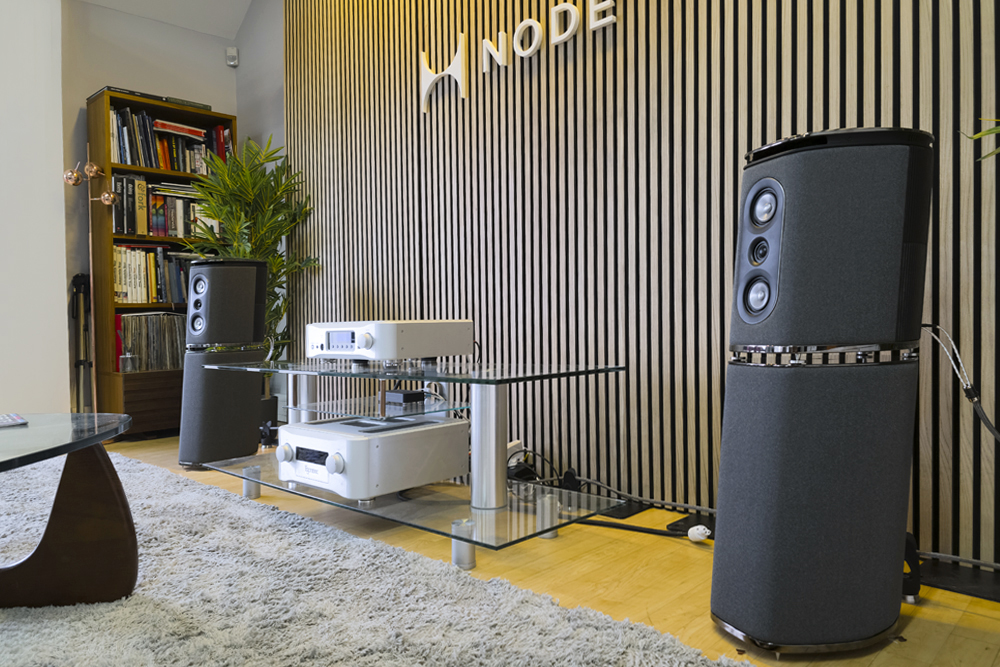 Node Audio Atom 525 loudspeakers on optional stands
Toward the end of the visit, May and Evans asked if I would like to review a pair, and I told them I would, providing they could get them over to North America. That didn’t seem to be an issue. I don’t yet know which model might arrive, but meaningful listening for me only really happens in my own room, where I know the acoustics and the associated equipment. If a review opportunity comes through, I look forward to reporting on what I hear—and discovering whether their sound is as impressive as the company’s tech and designs lead me to expect.
British hi‑fi: past and present
In the meantime, the visits to Monitor Audio and Node Audio left me thinking about something larger than either company individually. British hi‑fi has long been shaped by both continuity—think of all the BBC-inspired brands—and also change, which is necessary to evolve. Some companies have built their reputations over decades, refining ideas and expanding their reach. Others have arrived with fresh thinking, new technologies, and a determination to establish themselves, so that they might stick around long enough to become part of the old guard.
Monitor Audio represents the strength that comes from longevity and sustained investment. Node Audio represents the energy of a young firm trying to carve out its own place with some radical innovations. Seen together, they offer a reminder that the future of British hi‑fi will likely depend both on established brands continuing to evolve and on new ones bringing forward the ideas that will shape the next generation. There is clearly room for both approaches—and for consumers and enthusiasts alike, the coexistence of established expertise and new ideas can only be beneficial.
. . . Doug Schneider
das@soundstage.com